The First-Time Buyer's Guide to Buying a Home in Ontario
Buying your first home in Ontario comes with far more help than most people realize. The trouble is that the help is scattered: federal savings accounts, a provincial refund, city-run programs, and mortgage rules that changed only recently. This guide gathers all of it in one place, explains who actually qualifies for what, and lays out the order to tackle it in.
If you are months away from making an offer, or just starting to wonder whether this is even possible, this is the page to start on. I have kept it honest, including the parts that are not as generous as the headlines suggest and the one big program that is announced but not yet final.
What this guide covers
First, are you actually a first-time buyer?
Saving your down payment: the FHSA and the Home Buyers' Plan
What you get back: refunds, credits, and the new GST rebate
Help with the down payment itself
The mortgage rules that changed in your favour
So what do you do first?
Your first-time buyer checklist
First, are you actually a first-time buyer?
It sounds like a simple question. It is not, and getting it wrong can cost you thousands. Almost every program on this page uses the words "first-time buyer," but they do not all define it the same way.
The federal programs, which are the FHSA, the Home Buyers' Plan, the Home Buyers' Tax Credit, and the new GST rebate, generally use a four-year rule. In plain terms, you can qualify if neither you nor your spouse or common-law partner has owned a home you lived in during the current year or the four calendar years before it. So if you owned a home well in the past, you may have become eligible again.
Ontario's Land Transfer Tax refund is stricter. It asks whether you have ever owned a home anywhere in the world, and whether your spouse has owned one at any point while being your spouse. There is also a trap for couples: if you are buying together, both of you usually need to qualify to receive the full amount.
👉🏾 Download the First-Timer Buyer Guide (PDF)
"First-time buyer" does not mean the same thing in every program. Confirming which definition applies to you is the first real step, and it is one I am happy to walk through with you.
Saving your down payment: the FHSA and the Home Buyers' Plan
Two accounts do the heavy lifting here, and the good news is that you are allowed to use both for the same home.
The First Home Savings Account (FHSA)
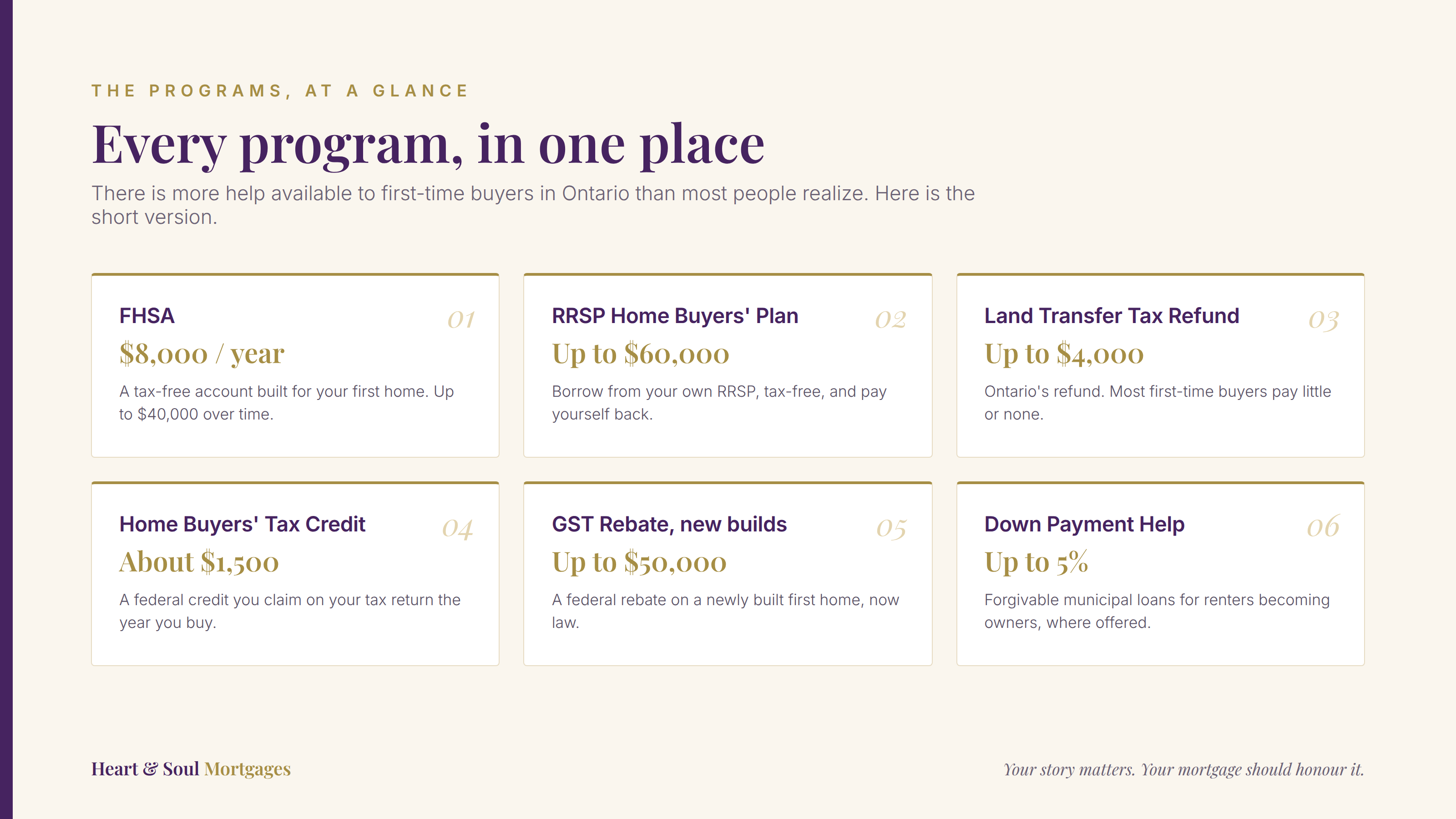
Up to $8,000 a year, $40,000 in total.
This is the account built specifically for a first home, and for most people it is the best place to put the first dollar. Your contributions lower your taxable income the way an RRSP does, and qualifying withdrawals for your first home come out completely tax-free, including any growth, the way a TFSA does.
You can contribute up to $8,000 each year, to a lifetime limit of $40,000. Unused room carries forward one year, so the most you can ever put in during a single year is $16,000. A couple who both qualify can each open one, for up to $80,000 between you.
The RRSP Home Buyers' Plan (HBP)
Up to $60,000 per person.
The Home Buyers' Plan lets you borrow from your own RRSP, tax-free, to fund your down payment, then pay yourself back over time. A couple who both qualify can withdraw up to $120,000 between them.
You repay into your RRSP over 15 years, beginning the second year after you withdraw. There is also a recent break worth knowing about: for a first withdrawal made between January 1, 2026 and December 31, 2028, the start of repayments is pushed back, giving newer buyers more breathing room. One thing to plan around: the money has to have been in your RRSP for at least 90 days before you can withdraw it this way.
If you can only fund one to start, the usual advice is to fill the FHSA first, because of the deduction, the tax-free growth, and the fact that you never have to pay it back. The Home Buyers' Plan is then a strong second layer when you need more.
What you get back: refunds, credits, and the new GST rebate
Ontario Land Transfer Tax Refund
Up to $4,000.
Ontario charges a land transfer tax when you buy, but first-time buyers get a refund of up to $4,000. That fully covers the provincial tax on a home priced up to roughly $368,000, so many first-time buyers pay little or none of it. Your lawyer normally applies it at closing, so you do not have to chase it. It works on both new and resale homes, and it can be claimed only once.
If you are buying inside the City of Toronto, there is a second, municipal land transfer tax, and a separate first-time buyer rebate of up to $4,475 on top of the provincial one. Toronto adjusted its municipal rates in 2026, so if you are buying in the city, please confirm the current figures with me before you budget.
First-Time Home Buyers' Tax Credit
About $1,500.
This is a federal credit you claim on your income tax return for the year you buy. It is worth about $1,500 in real tax savings. There is no separate application, but it is easy to forget at tax time, which means leaving money on the table. Put it on your list for the spring after you move in.
The new GST rebate on newly built homes
Up to $50,000.
This one is new. As of March 2026, eligible first-time buyers of a newly built home can have the federal GST removed entirely on homes priced up to $1 million, which is worth up to $50,000. Between $1 million and $1.5 million the rebate shrinks gradually, and above $1.5 million it does not apply. It is for new construction only, not resale.
There is an important caveat. Ontario has announced a matching rebate on its provincial portion, which would push the combined savings much higher, but that provincial piece is not yet final. The federal rebate is law. The Ontario layer is not, so please do not count on it until it is confirmed. I explain the full picture in my guide to the Ontario HST rebate.
Help with the down payment itself
Beyond saving and tax breaks, some communities offer direct help with the down payment. These programs vary a great deal from one place to another, so the most useful thing I can tell you is to ask which ones apply where you are buying.
In the City of London and Middlesex County, the Homeownership Down Payment Assistance Program offers renters an interest-free, forgivable loan of up to 5 percent of the purchase price, to a maximum of $25,000, which is forgiven over 20 years if you keep living in the home. It comes with income, asset, and price limits, and funding is first-come, first-served, so timing matters. Closer to home for me, the Region of Waterloo runs its own forgivable-loan program for eligible first-time buyers on homes up to $600,000.
Other municipalities across Ontario run similar programs with their own rules. Since I work with buyers right across the province, finding out whether one applies to you is part of what I do. It is worth asking before you assume you are on your own.
The mortgage rules that changed in your favour
These are not programs you apply for. They are recent changes to the rules, and they quietly changed what a first-time buyer can afford. This is the part I live in every day, so let me give you the honest version.
The insured mortgage cap is now $1.5 million. Until late 2024, any home priced at $1 million or more required a full 20 percent down payment. Now first-time buyers, and anyone buying new construction, can purchase up to just under $1.5 million with less than 20 percent down. The cut-off is sharp, though: at exactly $1.5 million, that option disappears and 20 percent is required again.
You can now choose a 30-year amortization. First-time buyers and buyers of newly built homes can stretch the mortgage to 30 years instead of the usual 25. This lowers your monthly payment and can help you qualify. Here is the honest trade-off, because it matters: a longer amortization costs you more in interest over the life of the loan. It is a useful tool, not free money, and whether it is right for you depends on your situation.
The minimum down payment has not changed. It is 5 percent on the first $500,000 of the price, and 10 percent on the portion above that. Below 20 percent down, you will also pay mortgage default insurance, which is added to your mortgage. And every buyer still has to pass the stress test, which means qualifying at a rate higher than the one you are offered. That last one surprises people, so it is worth building into your budget early.
One quick note, because clients still ask: the old First-Time Home Buyer Incentive, where the government took a share of your home in exchange for a larger down payment, was discontinued in 2024. If you remember hearing about it, it is no longer available.
So what do you do first?
It is a lot, I know. Here is the order I would suggest, and it doubles as a simple plan you can follow:
Open an FHSA now if you don't already have one, even with a small amount, to start the clock and the tax deduction.
Layer in the RRSP Home Buyers' Plan if you need more for your down payment.
Get a pre-approval with me. This includes a full credit check and gives you a real budget, and it is the point where house shopping should begin.
Check whether your municipality offers down payment assistance.
Once we have your pre-approval, you can start shopping for your home with your Realtor, now that your budget is firm.
At closing, your lawyer applies the Ontario Land Transfer Tax refund.
After you move in, claim the Home Buyers' Tax Credit on your tax return, and if you bought a new build, claim the GST rebate.
Your First-Time Buyer Checklist
Here is the whole journey as a simple checklist.
👉🏾 Download the First-Timer Buyer Guide (PDF)
Before you start looking
Open an FHSA, even a small amount, to start the clock and the tax deduction.
Map your down payment: FHSA, RRSP Home Buyers' Plan, savings, and any gift.
Get a pre-approval with your mortgage agent/broker. They pull a full credit report (which can show more than anything you would see on your own) and give you a detailed budget.
Confirm you qualify as a first-time buyer, since the rules differ from program to program.
Check whether your municipality offers down payment assistance.
Gather your income, tax, ID, and down payment documents for your agent.
Once you have your pre-approval, you are ready to shop
Work with a Realtor who knows your area and your price range.
Know your full cost: closing costs, land transfer tax, legal fees, and moving.
Understand your amortization choice, 25 years versus 30, and what each does to your payment.
Keep your pre-approval current and lock in a rate hold while you shop.
You have an offer, now what?!
Build in your conditions, especially financing and a home inspection.
Have your deposit ready.
At closing
Hire a real estate lawyer early.
Apply the Ontario Land Transfer Tax refund, which your lawyer usually handles at registration.
Confirm your final mortgage details and your cash to close.
After you move in
Note when your Home Buyers' Plan repayments begin, the second year after you withdraw.
Claim the First-Time Home Buyers' Tax Credit on next year's return.
If you bought a new build, claim the GST rebate.
Let us figure out your first home together
Every one of these programs has fine print, and the right combination depends on you. Bring me your situation, and I will walk you through exactly what you qualify for. 💜
Your story matters. Your mortgage should honour it.
Tiphereth "Tipper" Straker, Licensed Mortgage Agent, Level 2, Heart & Soul Mortgages, BRX Mortgage (FSRA #13463). Program figures are current as of 2026 and can change. This article is general information, not personalized financial or legal advice.